One of my favorite buildings in all of Los Angeles: the Scottish Rite Masonic Temple on Wilshire

The Scottish Rite cathedral was one of the most exciting projects I ever had anything to do with. It came to me in a strange way. The head of the Scottish Rite cathedral here in Los Angeles at the time. Judge Ellsworth Meyer, called me to ask me if I could go to dinner with a small group of people to discuss an “interesting subject.” I said, “Well, are you sure I could enter into the discussion?” He said, “Yes, we think you can.” I said, “Do you wish to discuss the subject matter?” He said, “No, not until dinnertime.” Well, I went to dinner at the [Los Angeles] Athletic Club with him …. They said, “We are going to build a new temple.” They called it a “cathedral.” I said, “Well, what kind of a cathedral?” They said, “Scottish Rite.” I was a little dopey. I thought it might be Masonic, but I wasn’t sure. I said, “Well, where is your old one?” I thought that might give me a clue, and they told me where it was, down on Flower Street, something like that. Then I knew that they were talking about a Masonic temple.
They said, “We are trying to be very thorough before we go ahead with this job. We have met nine firms of architects, of which at least the principal men are members of our particular Masonry degree and also our particular temple. We’ve discussed the matter at length with each of them, and we’ve asked them for their idea of how they would approach this problem. You’re the only one outside of the group that belong to the temple that we’ve interviewed. But we would like to discuss it with you ….” So they told me quite a bit about what has to be in a temple of this kind. I didn’t dream that there was a huge auditorium and a huge dining room. The auditorium seats 3,000, and the dining room seats 1,500, and they have many lodge rooms and recreation rooms. It’s a city, a tremendous thing …. I said, “…I’d have to know a lot more about you. As a matter of fact, the first question I would put at the top of my list is, ‘Why do you think you need to build a big temple? What’s wrong with the one you’ve got?’ I don’t know anything about the one you’ve got, except that I’ve seen the outside and it looks horrible. But,” I said, “that isn’t the important thing. The important thing is why do you think you need a temple? Maybe the idea of Masonry isn’t even practical today.” They really looked so shocked at that! I said, “I have no idea, not being a Mason, but I certainly believe that you should really answer a lot of questions. I don’t think it would make a damned bit of difference what I think you should do at this point, because I don’t know, and I don’t think any other designer or architect could tell you any better, unless of course they’re active members and have a lot of strong feelings, which I don’t have ….”
As a matter of fact, I was very busy, and I suddenly realized that about four months had gone by. I thought perhaps I had frightened them away completely by asking them the twenty-five or more questions of why they thought they ought to build a temple. Then the phone rang and it was Judge Meyer, the head of the Scottish Rite. He said, “Well, we’re ready to answer your questions.” So we set up another dinner party, and it was an exciting evening. It was one of the really most exciting ones because they had done their homework. They had worked terribly hard on all of the questions and had, I thought, some imaginative answers. They were not in any way tying me or any other designer down, but they had some very good thoughts about the new relationship of Masonry to society and why they felt this was an important time to build the temple and why they wanted to truly represent the spirit of Masonry. So without further ado, I made many sketches, I think three different concepts, which I presented to a smaller committee that they had decided would be easier to operate with …. I made the presentation of these three different concepts, from which they selected one. It was the one that we finally followed, but it grew considerably in the development, as most of these kinds of things do, both in character and in detail.
Well, I think I suggested to you that I was surprised by the tremendous number of things that had to be incorporated in this temple. First of all, the upper degrees of Masonry are given in an auditorium, and they are given in the form of plays. They have incredible costumes and magnificent productions of the basic concepts that are ethical and have at heart a religious depth, and they draw from many religions, as far as I understand. I’m not a Mason, but I do feel that it’s a tremendous attempt toward the freedom of man as an individual, and the rights of man as an individual, and respect for various races and creeds. I won’t say this is always obtained, but certainly that’s been the spirit. They felt that they wanted to depict this in every form. That’s the reason there’s so much decoration involved in the temple. The huge mosaic on the exterior east end of the temple at that time was the largest mosaic I’d ever made. It starts out with the builders of the temple from the days of Jerusalem, and King Solomon, who built the temple, and Babylon. Then it jumps up to the Persian emperor, Zerubabel …. I showed the importance of [Giuseppe] Garibaldi, the Mason who broke away from the Roman Catholic church because of what he felt was its limitations and dogmatism …. Then there is King Edward VII in his Masonic regalia as one of the great grand masters. We had the changing of the guard at Buckingham Palace, which is part of the King Edward section. I think the final part of that mosaic shows the first grand master of California in his full regalia being invested in Sacramento. It’s a kind of historical thing going way back to the ancient temple builders and coming right up through to actual California history, which the California sun at the top symbolizes.
…the concept of the sculpture along the south facade, which I worked in collaboration with Albert Stewart to design, and then he made all of the models — it seems to me there were eighty scale models, which I took to Rome and had carved by a very fine sculptor in solid travertine. These were, of course, eventually sent back and placed on the facade. And here again are all of the temple builders, each one representing a special builder going back to ancient Egypt and coming on through the time of King Solomon and the Persian emperor, up to and including George Washington. There are also Albert Pike, who was one of the very great men in the early part of the twentieth century or latter part of the nineteenth century, and Christopher Wren, who built the great cathedrals in England. The two St. Johns were interesting, because they were said to be patron saints, and they depicted two different meanings entirely. Then there’s the Gothic builder, so it symbolizes the whole meaning of the building of the temple .
…The double-headed eagle, which was the symbol for the Scottish Rite, Albert Stewart designed, and I think it makes a stunning logo. We used it in four spots on the temple. Then all of the inscriptions which we did were carved in travertine, and the different insignias of the degrees are all parts of the actual rites themselves …. On the inside, there are several sculptured and mosaic decorations on the interior of the auditorium. There’s a large mural depicting the history of Masonry in California, starting with the first houses which were erected by Masons. It’s all involved, and I can’t remember all the details. There’s also a large mural in the main reading room off the main library, which was not symbolic. It was the kind of thing I liked to do, a very interesting mood of some ancient trees, and it’s a totally different type of mural. Then I did murals in the dining room. The temple is like a city. It has a huge auditorium where they hold performances for the degree. Then there are four lodge rooms upstairs, where the various blue lodges meet to give the lower degrees. There is a recreational floor that has nothing but library facilities and pool tables and a combination of reading room and card room. There is a very fine library, which we had a lot of fun designing. There are, of course, the locker rooms and all of the other things that make it a tremendous, big building. It’s four stories above ground and one below. There is a huge dining room on the top floor that seats 1,500 people, where you get an excellent view of the city. It’s all under the overhang of that big roof that extends over the balcony areas. — Millard Sheets
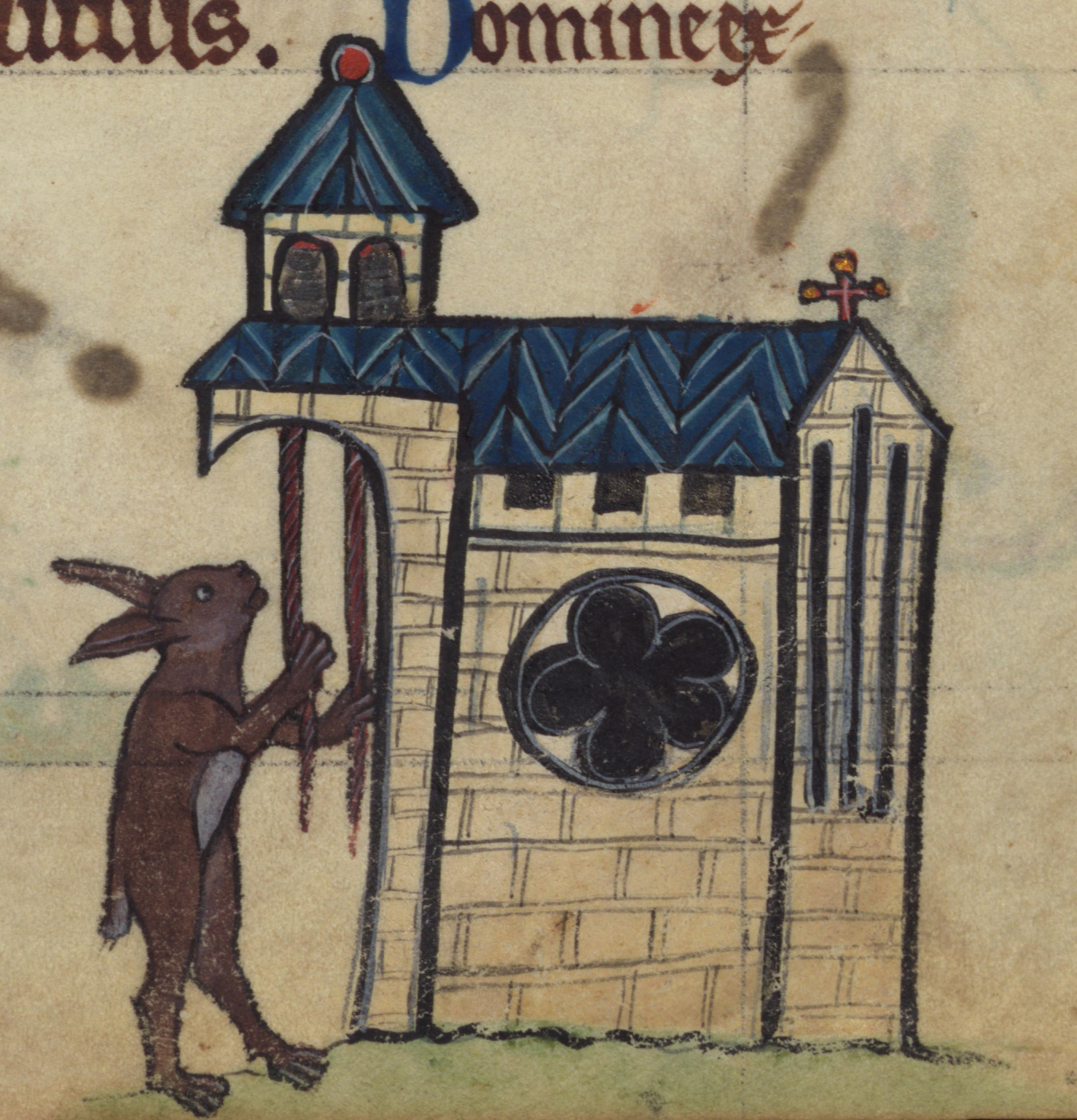
Book of Hours, Rabbit tolling church bells, from a marginal cycle of images of the funeral of Renard the Fox, Walters Manuscript W.102, fol. 81
[ source: Walters Art Museum Illuminated Manuscripts ]



[ source ]
Missing #2 of 5. Sorrow.

I, too, saw God through mud–
The mud that cracked on cheeks when wretches smiled.
War brought more glory to their eyes than blood,
And gave their laughs more glee than shakes a child.
Merry it was to laugh there–
Where death becomes absurd and life absurder.
For power was on us as we slashed bones bare
Not to feel sickness or remorse of murder.
I, too, have dropped off fear–
Behind the barrage, dead as my platoon,
And sailed my spirit surging, light and clear,
Past the entanglement where hopes lie strewn;
And witnessed exhultation–
Faces that used to curse me, scowl for scowl,
Shine and lift up with passion of oblation,
Seraphic for an hour, though they were foul.
I have made fellowships–
Untold of happy lovers in old song.
For love is not the binding of fair lips
With the soft silk of eyes that look and long.
By joy, whose ribbon slips,–
But wound with war’s hard wire whose stakes are strong;
Bound with the bandage of the arm that drips;
Knit in the welding of the rifle-thong.
I have perceived much beauty
In the hoarse oaths that kept our courage straight;
Heard music in the silentness of duty;
Found peace where shell-storms spouted reddest spate.
Nevertheless, except you share
With them in hell the sorrowful dark of hell,
Whose world is but a trembling of a flare
And heaven but a highway for a shell,
You shall not hear their mirth:
You shall not come to think them well content
By any jest of mine. These men are worth
Your tears: You are not worth their merriment.
“She said that she would dance with me if I brought her red roses,” cried the young Student; “but in all my garden there is no red rose.”
From her nest in the holm-oak tree the Nightingale heard him, and she looked out through the leaves, and wondered.
“No red rose in all my garden!” he cried, and his beautiful eyes filled with tears. “Ah, on what little things does happiness depend! I have read all that the wise men have written, and all the secrets of philosophy are mine, yet for want of a red rose is my life made wretched.”
“Here at last is a true lover,” said the Nightingale. “Night after night have I sung of him, though I knew him not: night after night have I told his story to the stars, and now I see him. His hair is dark as the hyacinth-blossom, and his lips are red as the rose of his desire; but passion has made his face like pale ivory, and sorrow has set her seal upon his brow.”
“The Prince gives a ball to-morrow night,” murmured the young Student, “and my love will be of the company. If I bring her a red rose she will dance with me till dawn. If I bring her a red rose, I shall hold her in my arms, and she will lean her head upon my shoulder, and her hand will be clasped in mine. But there is no red rose in my garden, so I shall sit lonely, and she will pass me by. She will have no heed of me, and my heart will break.”
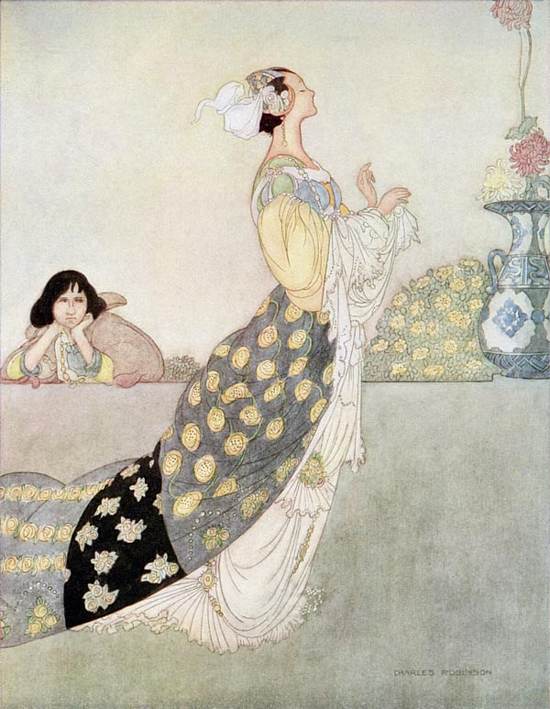
“Here indeed is the true lover,” said the Nightingale. “What I sing of, he suffers – what is joy to me, to him is pain. Surely Love is a wonderful thing. It is more precious than emeralds, and dearer than fine opals. Pearls and pomegranates cannot buy it, nor is it set forth in the marketplace. It may not be purchased of the merchants, nor can it be weighed out in the balance for gold.”
“The musicians will sit in their gallery,” said the young Student, “and play upon their stringed instruments, and my love will dance to the sound of the harp and the violin. She will dance so lightly that her feet will not touch the floor, and the courtiers in their gay dresses will throng round her. But with me she will not dance, for I have no red rose to give her”; and he flung himself down on the grass, and buried his face in his hands, and wept.
“Why is he weeping?” asked a little Green Lizard, as he ran past him with his tail in the air.
“Why, indeed?” said a Butterfly, who was fluttering about after a sunbeam.
“Why, indeed?” whispered a Daisy to his neighbour, in a soft, low voice.
“He is weeping for a red rose,” said the Nightingale.
“For a red rose?” they cried; “how very ridiculous!” and the little Lizard, who was something of a cynic, laughed outright.
But the Nightingale understood the secret of the Student’s sorrow, and she sat silent in the oak-tree, and thought about the mystery of Love.
Suddenly she spread her brown wings for flight, and soared into the air. She passed through the grove like a shadow, and like a shadow she sailed across the garden.
In the centre of the grass-plot was standing a beautiful Rose-tree, and when she saw it she flew over to it, and lit upon a spray.
“Give me a red rose,” she cried, “and I will sing you my sweetest song.”
But the Tree shook its head.
“My roses are white,” it answered; “as white as the foam of the sea, and whiter than the snow upon the mountain. But go to my brother who grows round the old sun-dial, and perhaps he will give you what you want.”
So the Nightingale flew over to the Rose-tree that was growing round the old sun-dial.
“Give me a red rose,” she cried, “and I will sing you my sweetest song.”
But the Tree shook its head.
“My roses are yellow,” it answered; “as yellow as the hair of the mermaiden who sits upon an amber throne, and yellower than the daffodil that blooms in the meadow before the mower comes with his scythe. But go to my brother who grows beneath the Student’s window, and perhaps he will give you what you want.”
So the Nightingale flew over to the Rose-tree that was growing beneath the Student’s window.
“Give me a red rose,” she cried, “and I will sing you my sweetest song.”
But the Tree shook its head.
“My roses are red,” it answered, “as red as the feet of the dove, and redder than the great fans of coral that wave and wave in the ocean-cavern. But the winter has chilled my veins, and the frost has nipped my buds, and the storm has broken my branches, and I shall have no roses at all this year.”
“One red rose is all I want,” cried the Nightingale, “only one red rose! Is there no way by which I can get it?”
“There is away,” answered the Tree; “but it is so terrible that I dare not tell it to you.”
“Tell it to me,” said the Nightingale, “I am not afraid.”
“If you want a red rose,” said the Tree, “you must build it out of music by moonlight, and stain it with your own heart’s-blood. You must sing to me with your breast against a thorn. All night long you must sing to me, and the thorn must pierce your heart, and your life-blood must flow into my veins, and become mine.”
“Death is a great price to pay for a red rose,” cried the Nightingale, “and Life is very dear to all. It is pleasant to sit in the green wood, and to watch the Sun in his chariot of gold, and the Moon in her chariot of pearl. Sweet is the scent of the hawthorn, and sweet are the bluebells that hide in the valley, and the heather that blows on the hill. Yet Love is better than Life, and what is the heart of a bird compared to the heart of a man?”
So she spread her brown wings for flight, and soared into the air. She swept over the garden like a shadow, and like a shadow she sailed through the grove.
The young Student was still lying on the grass, where she had left him, and the tears were not yet dry in his beautiful eyes.
“Be happy,” cried the Nightingale, “be happy; you shall have your red rose. I will build it out of music by moonlight, and stain it with my own heart’s-blood. All that I ask of you in return is that you will be a true lover, for Love is wiser than Philosophy, though she is wise, and mightier than Power, though he is mighty. Flame- coloured are his wings, and coloured like flame is his body. His lips are sweet as honey, and his breath is like frankincense.”
The Student looked up from the grass, and listened, but he could not understand what the Nightingale was saying to him, for he only knew the things that are written down in books.
But the Oak-tree understood, and felt sad, for he was very fond of the little Nightingale who had built her nest in his branches.
“Sing me one last song,” he whispered; “I shall feel very lonely when you are gone.”
So the Nightingale sang to the Oak-tree, and her voice was like water bubbling from a silver jar.
When she had finished her song the Student got up, and pulled a note-book and a lead-pencil out of his pocket.
“She has form,” he said to himself, as he walked away through the grove – “that cannot be denied to her; but has she got feeling? I am afraid not. In fact, she is like most artists; she is all style, without any sincerity. She would not sacrifice herself for others. She thinks merely of music, and everybody knows that the arts are selfish. Still, it must be admitted that she has some beautiful notes in her voice. What a pity it is that they do not mean anything, or do any practical good.” And he went into his room, and lay down on his little pallet-bed, and began to think of his love; and, after a time, he fell asleep.
And when the Moon shone in the heavens the Nightingale flew to the Rose-tree, and set her breast against the thorn. All night long she sang with her breast against the thorn, and the cold crystal Moon leaned down and listened. All night long she sang, and the thorn went deeper and deeper into her breast, and her life-blood ebbed away from her.
She sang first of the birth of love in the heart of a boy and a girl. And on the top-most spray of the Rose-tree there blossomed a marvellous rose, petal following petal, as song followed song. Pale was it, at first, as the mist that hangs over the river – pale as the feet of the morning, and silver as the wings of the dawn. As the shadow of a rose in a mirror of silver, as the shadow of a rose in a water-pool, so was the rose that blossomed on the topmost spray of the Tree.
But the Tree cried to the Nightingale to press closer against the thorn. “Press closer, little Nightingale,” cried the Tree, “or the Day will come before the rose is finished.”
So the Nightingale pressed closer against the thorn, and louder and louder grew her song, for she sang of the birth of passion in the soul of a man and a maid.
And a delicate flush of pink came into the leaves of the rose, like the flush in the face of the bridegroom when he kisses the lips of the bride. But the thorn had not yet reached her heart, so the rose’s heart remained white, for only a Nightingale’s heart’s-blood can crimson the heart of a rose.
And the Tree cried to the Nightingale to press closer against the thorn. “Press closer, little Nightingale,” cried the Tree, “or the Day will come before the rose is finished.”
So the Nightingale pressed closer against the thorn, and the thorn touched her heart, and a fierce pang of pain shot through her. Bitter, bitter was the pain, and wilder and wilder grew her song, for she sang of the Love that is perfected by Death, of the Love that dies not in the tomb.
And the marvellous rose became crimson, like the rose of the eastern sky. Crimson was the girdle of petals, and crimson as a ruby was the heart.
But the Nightingale’s voice grew fainter, and her little wings began to beat, and a film came over her eyes. Fainter and fainter grew her song, and she felt something choking her in her throat.
Then she gave one last burst of music. The white Moon heard it, and she forgot the dawn, and lingered on in the sky. The red rose heard it, and it trembled all over with ecstasy, and opened its petals to the cold morning air. Echo bore it to her purple cavern in the hills, and woke the sleeping shepherds from their dreams. It floated through the reeds of the river, and they carried its message to the sea.
“Look, look!” cried the Tree, “the rose is finished now”; but the Nightingale made no answer, for she was lying dead in the long grass, with the thorn in her heart.
And at noon the Student opened his window and looked out.
“Why, what a wonderful piece of luck!” he cried; “here is a red rose! I have never seen any rose like it in all my life. It is so beautiful that I am sure it has a long Latin name”; and he leaned down and plucked it.
Then he put on his hat, and ran up to the Professor’s house with the rose in his hand.
The daughter of the Professor was sitting in the doorway winding blue silk on a reel, and her little dog was lying at her feet.
“You said that you would dance with me if I brought you a red rose,” cried the Student. “Here is the reddest rose in all the world. You will wear it to-night next your heart, and as we dance together it will tell you how I love you.”
But the girl frowned.
“I am afraid it will not go with my dress,” she answered; “and, besides, the Chamberlain’s nephew has sent me some real jewels, and everybody knows that jewels cost far more than flowers.”
“Well, upon my word, you are very ungrateful,” said the Student angrily; and he threw the rose into the street, where it fell into the gutter, and a cart-wheel went over it.
“Ungrateful!” said the girl. “I tell you what, you are very rude; and, after all, who are you? Only a Student. Why, I don’t believe you have even got silver buckles to your shoes as the Chamberlain’s nephew has”; and she got up from her chair and went into the house.
“What I a silly thing Love is,” said the Student as he walked away. “It is not half as useful as Logic, for it does not prove anything, and it is always telling one of things that are not going to happen, and making one believe things that are not true. In fact, it is quite unpractical, and, as in this age to be practical is everything, I shall go back to Philosophy and study Metaphysics.”
So he returned to his room and pulled out a great dusty book, and began to read.
Day 10! So far, so good. I honestly feel that this practise has made some impact on my overall well-being. The effect is hard to define: I’m a little more centered, a little more even-tempered, and I’m more adept at shrugging off the small shit. I’m also sleeping a bit better at night. Go figure.